
Imagine you are on Ethereum mainnet, about to approve a large allowance to a freshly audited-looking DEX contract. Your browser asks for a signature; you could click “confirm” the way you always do. Or you could pause — and let the wallet simulate what will happen to your balances if you sign. That second option is the core user experience Rabby promotes. But simulation is a tool, not a panacea. This article walks through the mechanics of Rabby’s transaction simulation, corrects common misconceptions about what simulation means in practice, and gives a pragmatic framework for when and how DeFi power users in the US should lean on it versus other controls.
Short version: Rabby’s pre-sign simulation and risk scanning reduce several important attack surfaces (blind signing, accidental approvals, network confusion), but they do not eliminate systemic protocol risk, front-running at-chain, or social-engineered compromises of private keys. If you need a quick decision rule: use simulation to detect behavioral anomalies in a transaction, combine it with hardware wallets and approval revocation for exposure control, and reserve multisig for institutional or high-value positions.
How Rabby’s transaction simulation works — mechanism, not magic
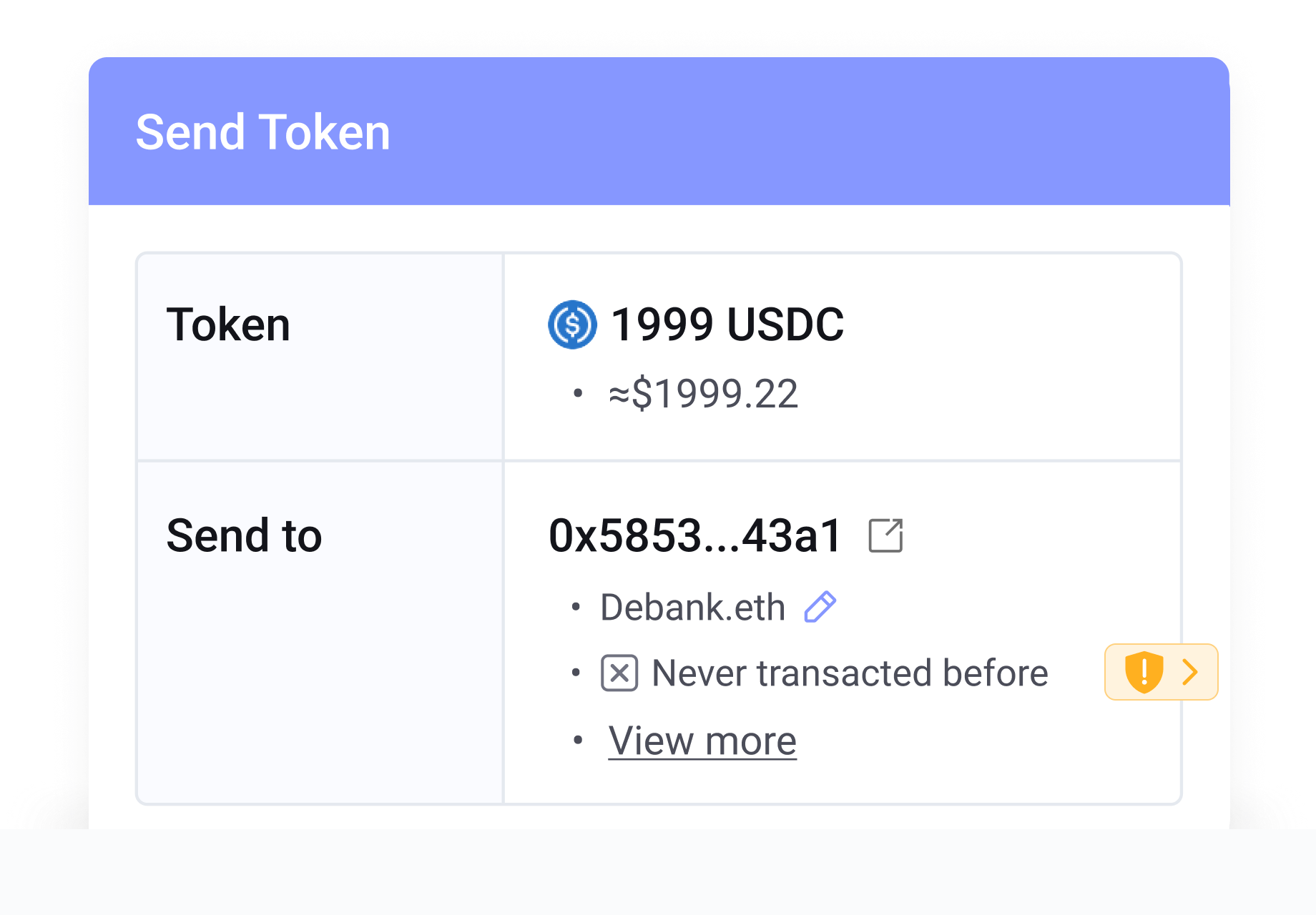
At the mechanism level, Rabby intercepts the transaction a dApp requests, reconstructs the transaction call data, then runs an off-chain simulation against a local or remote node to estimate the effects on token balances and on-chain state. Practically, the wallet shows you: token inflows/outflows you can expect, the projected fee in native gas token, and a set of risk flags produced by its scanner (for example, “contract previously exploited” or “suspicious approval”). These outputs are displayed before you sign, giving you a detailed “what will change” readout rather than just the raw calldata hex.
This matters because blind signing — approving arbitrary calldata without a decoded preview — has been a root cause in many user losses. A decoded, balance-aware preview concretely translates the abstract contract call into units you care about. But the key limitation to understand: simulation is predictive, not authoritative. It depends on the node state used, assumptions about gas limits and reverts, and cannot anticipate on-chain events that happen between simulation and actual inclusion in a block.
Common myths vs reality
Myth 1: “If Rabby simulates it and the simulation looks safe, the transaction is safe.” Reality: simulation reduces information asymmetry but does not remove the protocol-level or timelinked risks that can cause loss. Examples: a protocol with a hidden admin key, an exploitable liquidity pool, or a flash-loan attack vector can still drain funds after your transaction—simulation won’t necessarily flag those unless the scanner has prior knowledge and heuristics covering them.
Myth 2: “Simulation eliminates front-running and MEV risks.” Reality: MEV (miner/extractor value) and front-running happen on-chain during ordering and inclusion; a pre-sign simulation cannot control transaction ordering, nor can it prevent sandwich attacks. What simulation can do is show if a transaction will give a contract unlimited approval or other high-exposure actions that make MEV exploitation easier.
Myth 3: “Open-source wallets are inherently secure.” Reality: open-source code increases auditability and community scrutiny (and Rabby is MIT-licensed), but it does not guarantee that all code paths are safe or that connected smart contracts are secure. Rabby’s 2022 swap-contract exploit is a reminder: team response, freezing and remediation matter as much as the license type.
Where Rabby meaningfully reduces real user risk
There are concrete, repeatable ways Rabby changes the risk equation for advanced users:
– Prevents blind signing: showing token deltas and explicit gas fees turns an opaque calldata string into a readable, numeric consequence. That frequently catches suspicious approval requests and mistaken transfers.
– Pre-transaction risk scanning: by checking whether contracts have known compromises, or whether a recipient address is zero or contract-less, Rabby reduces simple but common mistakes.
– Approval revocation integrated: active allowance management is one of the most effective user-side mitigations against later contract exploits. Having revocation in-wallet lowers the friction versus using external tools.
– Automatic network switching and cross-chain gas top-up: these usability features reduce incorrect-chain errors (sending a token on the wrong network) and the need to manually transfer gas tokens — both practical sources of lost time and occasional mistakes.
Where it does not protect — trade-offs and limits
Understanding failure modes is the most decisive way to use Rabby well. Important limits:
– No protection against compromised private keys: if your seed phrase or hardware key is phished or exfiltrated, simulation won’t help. The defensive stack must include secure custody (hardware wallets, multisig) and operational security.
– Not a substitute for on-chain risk analysis: simulation is a single-transaction lens. Systemic protocol vulnerabilities—bad or malicious contract logic, hidden owner privileges, yield strategies that rely on centralized oracles—require a deeper audit trail or third-party security intelligence.
– Simulation is as good as the node and heuristics behind it: state divergences, mempool differences, or incomplete heuristics can yield false negatives (missed threats) or false positives (harmless things flagged). Users should treat risk flags as prompts to investigate, not as definitive judgments.
Practical workflow for DeFi power users in the US
Here is a compact decision framework you can reuse when interacting with dApps using Rabby in a high-stakes US regulatory and market environment:
1) Pre-sign checklist (use Rabby’s simulation): confirm token deltas, check gas estimate, and review risk flags. If an approval is requested, note the allowance size—prefer finite allowances where possible.
2) High-value gate: for transfers or approvals above a threshold you define, use a hardware wallet or require a second device. Rabby’s hardware integrations (Ledger, Trezor, etc.) make this practical.
3) Ongoing exposure control: run periodic approval revocation sweep using Rabby’s native tool and track positions via the aggregated portfolio dashboard. For institutional holdings or multi-user operations, favor Gnosis Safe or similar multisig integrations Rabby supports.
4) If the transaction triggers a red flag you don’t understand, pause and investigate off-line. Simulation buys time and information — don’t let it substitute for a forensic pause.
Comparing Rabby to common alternatives — where it stands out
MetaMask, Trust Wallet, and Coinbase Wallet remain dominant for different reasons (ecosystem ubiquity, mobile convenience, brand trust). Rabby’s differentiators are operational: built-in simulation, automatic network switching, and approval management. Those features shift risk from the user’s cognitive load into a consistent, repeatable UI step. The trade-off is complexity: power users must learn to interpret simulations correctly and integrate them into custody and approval workflows rather than assume they are infallible guards.
Institutional users will find the ecosystem integrations (Gnosis Safe, Fireblocks, Amber, Cobo) useful because they allow Rabby’s UX to fit into stronger custody or treasury workflows. But the ultimate security depends on how these integrations are configured: a multisig with weak signer controls remains vulnerable to social or insider attacks.
Non-obvious insights and a more precise mental model
Two sharpened ways to think about simulation that change behavior:
– Simulation is a lap-level safety device, not an engine-room inspection. It checks the immediate arithmetic and known heuristics for a transaction; it does not, by itself, audit protocol economics or governance risk. Treat it like a car’s pre-trip checklist, not its structural inspection.
– Combine “what will change” with “who can change it.” A small token delta to a contract with an owner-only emergency drain is not the same as the same delta to an immutable AMM pool. Simulation tells you the delta; external intelligence about contract ownership and multisig controls tells you the “who can change it.” Your security decision should combine both.
What to watch next (conditional scenarios)
Signals that would change the calculus for Rabby’s value proposition:
– Broader embedding of MEV-mitigation into relayers and RPC providers could make post-sign protections more effective; if relayers offer ordering guarantees, the gap between simulation and on-chain outcomes narrows.
– If Rabby expands built-in on-chain analytics (automatic detection of admin keys, proxy upgrades, or hidden owner functions), simulation would become more prescriptive. Conversely, if the project does not keep its heuristics current, simulated outputs may degrade in usefulness over time.
– Regulatory or compliance shifts in the US that affect on-ramps could raise demand for wallets that integrate fiat rails; Rabby currently lacks a built-in fiat on-ramp, so market pressure could push feature expansion or partnerships with compliant providers.
FAQ
Does Rabby’s simulation prevent phishing or compromised seed phrases?
No. Simulation does not prevent phishing attacks that lead to exposed seeds or private keys. It reduces the risk of blind signing but cannot help if the attacker is controlling the signer. Always use hardware wallets for significant funds and follow operational security best practices.
Can I rely on Rabby’s risk flags to decide whether a contract is safe?
Risk flags are informative but not definitive. They reflect heuristics and known incident databases; they may miss novel exploits or generate false positives. Use flags as prompts for additional checks — examine contract ownership, recent upgrades, audit statements, and on-chain behavior before trusting large transfers.
How does Rabby interact with hardware wallets and multisig setups?
Rabby integrates with major hardware wallets (Ledger, Trezor, Keystone, and others) and supports multisig solutions like Gnosis Safe. Use a hardware wallet as the signer when possible; for institutional or large-value accounts, use multisig to distribute signing authority and reduce single-key failure modes.
Is there a mobile or desktop Rabby client, or is it only a browser extension?
Rabby is available as a Chromium-based browser extension, mobile apps for iOS and Android, and desktop clients for Windows and macOS. Choose the platform that fits your operational security model; for example, a dedicated desktop client plus a hardware signer can reduce exposure compared with using a general-purpose mobile device.
For readers wanting to try the wallet and examine its interface and documentation, a straightforward entry point is the official informational page for rabby. Use that as a starting point for hands-on testing, but validate any workflow with hardware keys and small-value dry runs before committing significant funds.
In closing: Rabby’s transaction simulation reframes a known vulnerability — blind signing — into a solvable UX problem. That is a meaningful improvement for DeFi power users who routinely sign complex calldata. But it should be one tool among many: simulation for clarity, hardware and multisig for custody, approval revocation for exposure control, and external protocol intelligence for systemic risk. Treat simulation as necessary and useful, but not sufficient; the smarter posture is to ask “what else could change this outcome” every time the preview looks clean.